
Anyone who's ever filled a police training coordinator spot (as I have, in a small agency) knows how difficult it is to schedule training classes. Massaging a 24/7/365 schedule that's already understaffed is no easy task. Shift shortages. Overtime costs. Labor union issues. Disrupting sleep patterns. Interrupting day-off patterns.
In the police supervisor training course world, there are two (2) prevailing schedules:
- ten (10) weeks straight, Monday through Friday, daytime.
- alternating two (2) weeks in class, daytime; two (2) weeks back at work on whatever watch you're assigned; for eighteen (18) weeks.
I use ten (10) weeks as a benchmark "in-person time" because that's the duration of some of the nation's more popular programs. Could I cram my suggested curriculum inside six (6) or eight (8) weeks? Possibly. Could I extend it to twelve (12) weeks? Possibly.
Take the second alternating schedule. I've participated in that format. As a Monday through Friday day shift "house mouse," it wasn't difficult on my body. For classmates who returned to a night shift lifestyle every two (2) weeks... it was brutal. A serious advantage to the alternating schedule was having time between those in-person weeks to complete assignments, projects, book readings, and papers.
In-person phases are critical. I don't care how much you support "work-from-home." There is something to be said about stuff that gets connected when you are sitting or standing next to someone. Or sharing lunch with them. Or going out for beers or margaritas after class. In all aspects of learning, socialization matters. Only so much can be done online.
All modern learning research points to time-spaced-repetition as the most effective educational model. The opposite of time-spaced-repetition is blocking, which is identified among the least effective educational schedules. So then, why do police agencies schedule training in blocks? Because it's easier administratively.
When I was a Department training coordinator, I bought into the concept of
blended learning (<<< link to an old article I wrote on this). Officers would participate in self-paced, asynchronous, online learning for the info-dump, lecture stuff, and quizzes/tests. Then, when they attended group in-person sessions, it was a quick review, discussion, debate, simulations, drills, and scenarios. We maximized our synchronous, in-person time for doing that which needed to be done in-person!
My favorite extended training scheduling pattern is by the
Naval Postgradute School. I really want(ed) to attend their
Masters Degree course! Check out this condensed excerpt explaining the schedule format (emphasis added is mine):
...program requires 18 months of continuous enrollment ... It involves a significant commitment on the part of the participants and their agencies... Each quarter requires two weeks in residence ... The remainder of the coursework is completed via network-based learning. Participants spend an average of 15-20 hours per week during the network-based learning periods of study—reading assigned materials, participating in online discussions with faculty and other participants, and preparing papers and projects. Participants and their agencies must be cognizant of this commitment and should view it as an investment...
So, I'm a bit conflicted on how I'd organize my command school's schedule.
I'd prefer it to be one (1) week in-person per month or so, for ten (10) or twelve (12) months. Perhaps two (2) weeks in-person at a time, every two (2) months? The conflict arises because I understand that administrative scheduling ease still matters; there must be a balance with the learning research and science in order for any program to be attended. Would I extend the in-person sessions to three (3) weeks each, with longer online, self-paced breaks? Possibly.
What I do know is that it is vital to adhere to the spaced-time-repetition concept, through a blended, hybrid model of learning.
What would be done during those "breaks" between in-person sessions? Books. Podcasts. Videos.
Coursera-type courses. (I'm actually taking
this Coursera course right now...) Other MOOCs. Online discussions. Relevant work projects. Group assignments. Peer project critique and review.
I said earlier that this would be a commitment. As someone who attended university while being a full-time detective with a working wife and busy kids, I wouldn't wish that level of difficulty on participants. It won't be inconvenient for the sake of being difficult. But we can't simply ignore contemporary learning research on how human's remember, grow, and adapt best. The scheduling concept is a big part of that.
***
This is part of an on-going series on how Lou would design his own training course for police supervisors and command staff. What qualifies him to take on such a position? Not much more than a website and a keyboard. Yes, he's aware that several programs already exist in this space. No, he's not actually going to offer his course. But if you'd like to see all the posts in this series anyways, click here.
***
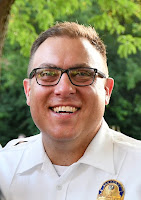
Lou Hayes, Jr. is a detective supervisor in a suburban Chicago police department, collaterally detailed to a regional major crimes (homicide) task force. He has a passion for multi-jurisdictional crime patterns, criminal networks, & regional intelligence. With a background in training, he studies human performance, decision-making, creativity, emotional intelligence, & adaptability. Lou is a volunteer within the National Real-Time Crime Center Association (NRTCCA), serving as Director of Joint Operations. Follow Lou on LinkedIn, & also the LinkedIn page for The Illinois Model. ***


Comments
Post a Comment